

How to Run a Sub-1:30 Half Marathon
The fitness benchmarks, decisive workouts and race-day pacing needed to average 4:16/km or 6:52/mile for 21.1 kilometres.
The short answer: learning how to run a sub-1:30 half marathon starts with the pace requirement: you need to average slightly faster than 4:16 per kilometre or 6:52 per mile. Build enough easy volume to support one threshold session, one long run and regular race-pace work, then begin the race controlled. A sub-90 attempt usually fails because the goal is ahead of current fitness or the first five kilometres are too aggressive—not because the runner lacked one magical workout.
If two hours is the more realistic next milestone, start with the sub-2-hour half-marathon guide for the 5:41/km target, readiness benchmarks and race plan.
\nBreaking 1:30 is a meaningful target. It demands speed, but the harder problem is sustaining a high fraction of that speed for ninety minutes. The best preparation therefore combines aerobic consistency, controlled threshold work, long-run durability and repeated exposure to goal pace without turning every week into a race.
This guide explains how to run a sub 1:30 half marathon without pretending one benchmark or training schedule suits everyone. Use recent evidence from training and shorter races, account for the course and weather, and treat 1:30 as an outcome to earn rather than a pace to force.
Sub-1:30 half-marathon pace and splits
A 1:30:00 half marathon equals approximately 4:16/km or 6:52/mile. Because GPS watches can measure long and race courses rarely follow a perfectly straight line, aiming for exactly 4:15.9 on your watch leaves little margin. Use official kilometre or mile markers to check progress and allow a small buffer without racing the opening kilometres.
| Checkpoint | Even-split target | Practical race range |
|---|---|---|
| 5 km | 21:20 | 21:20–21:30 |
| 10 km | 42:40 | 42:40–42:55 |
| 15 km | 1:04:00 | 1:03:55–1:04:15 |
| 20 km | 1:25:19 | 1:25:10–1:25:30 |
| Finish | 1:30:00 | Under 1:30 |
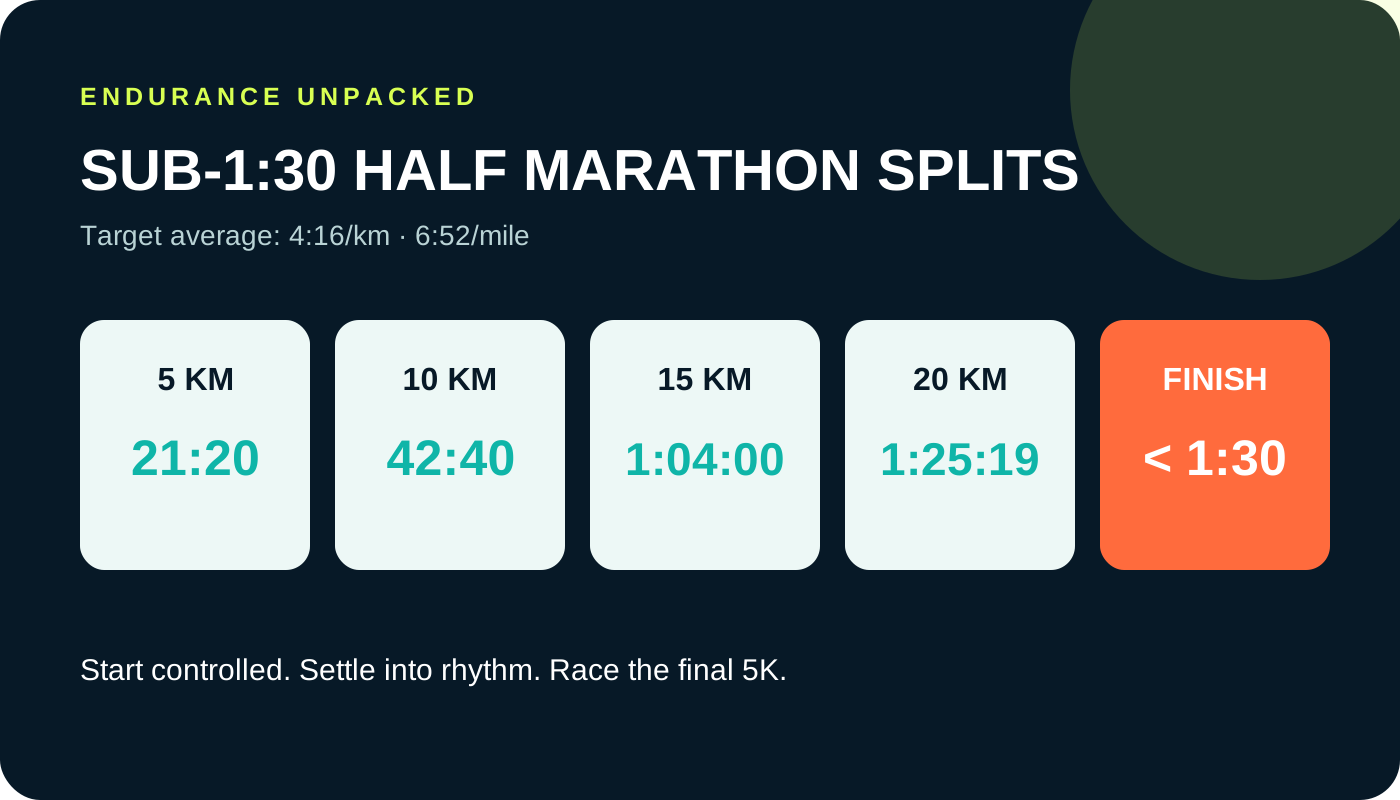
The practical ranges deliberately allow a controlled start. If you pass 5 km in 20:45 because you feel fresh, you have not banked useful time; you have increased the chance that the final five kilometres become disproportionately expensive. Better half-marathon performers tend to show more even pacing, although course profile and wind still matter. Use the full half-marathon pacing strategy to adapt the opening, middle and final five kilometres.
Use the Running Pace & Split Calculator to generate mile splits or adjust the target for another finish time.
How to Run a Sub-1:30 Half Marathon: Readiness Benchmarks
When assessing how to run a sub-1:30 half marathon, no single workout guarantees a result. Readiness is stronger when several independent signals agree: recent race performance, consistent weekly volume, threshold control and the ability to finish long runs without needing several days to recover.
| Evidence | Encouraging range | Important limitation |
|---|---|---|
| Recent 5K | Approximately 19:15–20:00 | Short-race speed does not prove endurance |
| Recent 10K | Approximately 40:00–41:30 | Course and conditions must be comparable |
| Weekly running | Often 35–55+ km, built gradually | There is no universal mileage requirement |
| Long run | 90–115 minutes completed comfortably | It should not become a weekly race |
| Race-pace work | 6–9 km total near 4:16/km in controlled repetitions | Good execution matters more than forcing the pace |
These are guidelines, not entry requirements. A speed-oriented runner may break 1:30 on lower mileage, while an endurance-oriented runner may need more aerobic volume despite a modest 5K time. Studies of recreational half-marathon runners associate weekly training distance, physiological measures and longer endurance runs with performance, but prediction remains individual.
How to Run a Sub-1:30 Half Marathon in Training
A strong week is central to how to run a sub-1:30 half marathon successfully. It has a clear hierarchy. Most running remains easy enough to support the work that matters. One controlled quality session develops threshold or speed endurance; one long run develops durability; and later weeks add carefully measured half-marathon-specific work.
| Day | Four-run structure | Five-run structure |
|---|---|---|
| Monday | Rest or mobility | Rest or mobility |
| Tuesday | Threshold, hills or intervals | Threshold, hills or intervals |
| Wednesday | Rest or strength | Short easy run + strength |
| Thursday | Easy run + strides | Easy run + strides |
| Friday | Rest | Rest |
| Saturday | Easy or controlled steady run | Easy or controlled steady run |
| Sunday | Long run | Long run |
For a complete schedule, use the 12-week four-day half-marathon plan or the broader intermediate 12-week framework. The goal is not to add every possible workout. It is to repeat an appropriate load long enough for it to become normal.
Five key workouts for a sub-1:30 attempt
1. Controlled threshold blocks
Start with 3 × 8–10 minutes at a comfortably hard effort with two minutes of easy jogging. Progress toward 2 × 15 minutes or 3 × 12 minutes. The guide to the best threshold workouts for half-marathon training includes five formats and a six-week progression. Threshold training should finish with control; it is not a time trial. Depending on current fitness and conditions, the pace may sit slightly faster than half-marathon goal pace, but effort is the primary constraint.
2. One-kilometre repetitions around current 10K effort
Run 5–6 × 1 km with roughly two minutes of easy recovery. These repetitions improve speed endurance and make 4:16/km feel mechanically familiar without requiring a long continuous effort. Base the pace on current 10K ability, not the 10K time you believe a sub-1:30 runner should have.
3. Half-marathon-pace cruise intervals
Use sessions such as 3 × 3 km at approximately goal effort with three minutes easy, or 2 × 4 km with four minutes easy. Complete these in the final third of the build rather than every week. The correct session feels controlled early and demanding by the final repetition, with no sprint finish required.
4. Long easy run
Build toward approximately 100–115 minutes if your training history supports it. Most long runs should remain easy. Every second or third week, an experienced runner may finish 15–25 minutes at a steady effort. You do not need to run the full 21.1 km in training to prove you can race it.
5. Easy running with strides
Easy volume supports aerobic development and recovery between demanding sessions. Add four to six relaxed strides of 15–25 seconds after an easy run once or twice per week. Strides maintain coordination and speed without becoming another hard workout.
Build a training week that survives real life
Get the free Race-Ready Week printable template and editable planner. Prioritize the sessions that matter, protect recovery and prepare a fallback before work or travel changes the plan.
How to progress the final six weeks
| Weeks to race | Primary session | Long-run emphasis |
|---|---|---|
| 6 | 2 × 15 min threshold | 95–105 min easy |
| 5 | 5 × 1 km around 10K effort | 100–110 min, final 15 min steady |
| 4 | 3 × 12 min threshold | 105–115 min easy |
| 3 | 3 × 3 km at half-marathon effort | 100–110 min easy |
| 2 | 2 × 4 km at half-marathon effort | 80–95 min controlled |
| Race week | 3 × 5 min at half-marathon effort | Race |
This is a session progression, not a complete individualized plan. Reduce work duration if these sessions are new, and do not add them on top of an already demanding programme. A taper should reduce accumulated fatigue while retaining some familiar intensity.
Strength training without damaging key runs
One or two short strength sessions can support running economy and robustness. Prioritize familiar movements such as a squat or split squat, hip hinge, calf raise and trunk exercise. Place strength after a quality or easy run, or on a day that still leaves adequate recovery before the long run.
Do not begin a high-volume plyometric or maximal-strength programme close to the race. During specific training, maintenance is enough: clean technique, a small number of useful sets and repetitions left in reserve.
Sub-1:30 race-day pacing plan
Kilometres 0–5: control the excitement
Aim near 4:17–4:18/km on a flat course and accept a few seconds behind the theoretical schedule. Settle breathing, avoid weaving and do not chase runners who opened too quickly. Passing 5 km around 21:20–21:30 keeps the target alive without spending the race in the first quarter.
Kilometres 5–15: build boring consistency
Move toward 4:15–4:16/km when conditions allow. Use official markers to check your watch. Focus on relaxed shoulders, direct lines and manageable effort. At 10 km, approximately 42:40–42:55 is a useful range. The race should feel serious but not desperate.
Kilometres 15–20: protect pace through effort
This is where durability matters. Maintain effort on small rises rather than forcing exact pace, then use descents and sheltered sections efficiently. If you are still controlled after 17–18 km, begin reducing any small deficit gradually.
Final 1.1 km: race what remains
After 20 km, stop saving energy. Increase cadence, use nearby runners and commit to the line. If you reach 20 km close to 1:25:20, approximately 4:40 remains for the final 1.0975 km.
Adjusting for hills, heat and wind
Understanding how to run a sub-1:30 half marathon also means adapting to the course and conditions. Exact even pace is appropriate only when both are even. On hills, hold a sustainable effort and accept slower uphill kilometres. In a headwind, use a group without surging repeatedly. Heat and humidity increase physiological strain, so a cool-weather sub-1:30 target may not be realistic on a hot day.
Decide before the race whether the goal is strictly time or the best possible performance in the conditions. Forcing 4:16/km when the environment makes that effort unsustainable usually produces a slower finish than adjusting early.
Fueling and hydration
Fueling is another practical part of how to run a sub-1:30 half marathon. A ninety-minute race sits at a duration where carbohydrate during exercise may support performance, but the best strategy is one you have practised. Many runners use one gel shortly before the start or during the first half, with another later if tolerated. Product carbohydrate content varies, so count grams rather than assuming every gel is identical.
Use aid stations deliberately and avoid drinking large amounts out of anxiety. Weather, sweat rate and personal tolerance matter. Nutrition and hydration advice here is general education, not individualized medical guidance.
Seven mistakes that ruin sub-1:30 attempts
- Choosing the goal from desire alone. Use recent training and races.
- Running easy days at “almost steady.” This reduces the quality of decisive sessions.
- Testing goal pace every week. Race-specific work is useful; repeated time trials are costly.
- Turning every long run into a progression. Durability grows through repeatable training.
- Opening the race below 4:10/km. Early seconds are expensive later.
- Ignoring conditions and course profile. Effort determines sustainability.
- Repaying missed mileage. Compressing the week often damages the next one.
Frequently asked questions
How to run a sub-1:30 half marathon at the correct pace?
Approximately 4:16 per kilometre or 6:52 per mile. Exact mathematical pace is about 4:15.9/km.
What 10K time suggests sub-1:30 potential?
Approximately 40:00–41:30 is encouraging for many runners, but it is not a guarantee. A runner near the slower end needs strong endurance and specific preparation; a faster 10K runner can still fail through inadequate durability or poor pacing.
How many kilometres per week are needed?
There is no universal threshold. Many sub-1:30 runners train somewhere around 35–55 km or more per week, but training history and how that volume is distributed matter more than copying a number.
Can I break 1:30 running four days per week?
Yes. Four days can accommodate one quality session, two supporting runs and a long run. Consistency and adequate total volume matter more than running every day.
Should I use a pace group?
A well-managed 1:30 pace group can reduce decision-making and help in wind, but pacers vary. Confirm whether they target gun or chip time and keep responsibility for your own effort.
Want the complete editable plan?
The complete package includes English and French 14-page guides, four- and five-day schedules, an editable workbook, missed-session rules, taper and race-week tools.
Get the complete plan — €19Sources and further reading
- Predictors of half-marathon performance in recreational athletes.
- Pacing differences across performance levels in marathon and half-marathon runners.
- Training volume and longest endurance run related to half-marathon performance.
- Predictive variables of half-marathon performance.
- World Athletics: Half Marathon.
Complete the half-marathon block
Arrive fresh with the final two-week taper, plan when to take your gels, and use the missed-week return guide when real life interrupts training.
Editorial note: Vincent Meheut is an amateur runner and long-course triathlete, not a certified coach. He has run a 1:24:43 half marathon. This article combines first-hand experience with the cited research and is provided for general education only.