

How Long Should Your Long Run Be Before a Half Marathon?
Choose a peak long run that builds endurance without stealing recovery from the rest of your week.
The short answer: how long should your long run be before a half marathon? For many runners, a peak long run of 90–120 minutes—often about 10–14 miles (16–23 km)—is enough. Beginners may peak at 8–11 miles, while experienced runners may cover 12–16 miles. You do not have to run the full 13.1 miles in training. Your ideal distance depends on pace, weekly volume, training history and recovery.
The long run is important, but it is not an exam you must pass before race day. Its purpose is to develop aerobic endurance, improve fatigue resistance and practise pacing, fueling and equipment. It should strengthen the training week rather than leave you unable to train for several days.
This guide explains how long should your long run be before a half marathon for different experience levels, how quickly to build it, when to include race-pace work and how far from race day to schedule the peak.
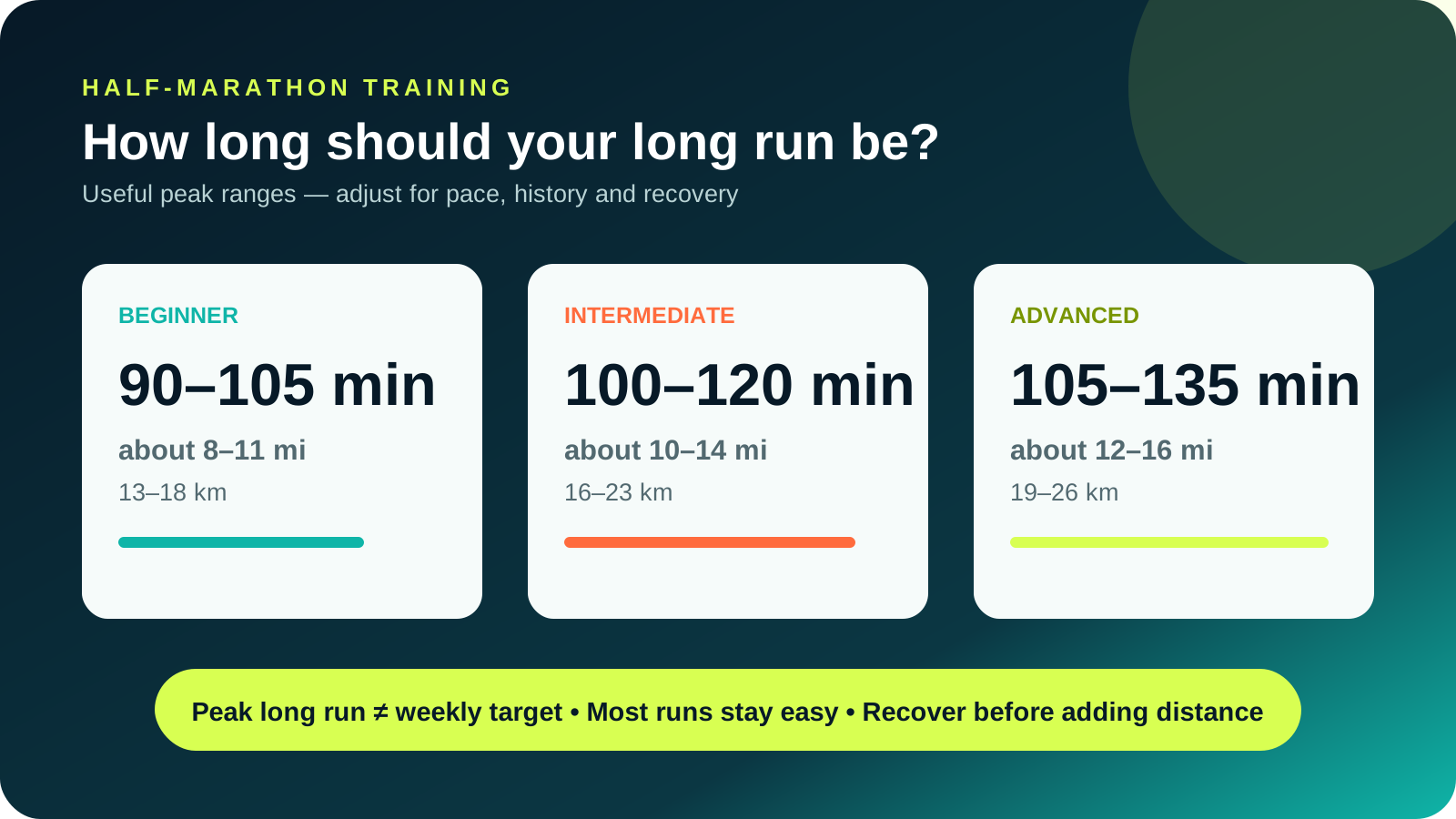
How Long Should Your Long Run Be Before a Half Marathon?
| Runner | Peak duration | Approximate distance | Main purpose |
|---|---|---|---|
| Beginner / first half | 90–105 min | 8–11 mi / 13–18 km | Build confidence and durable easy running |
| Intermediate | 100–120 min | 10–14 mi / 16–23 km | Build endurance and add controlled specificity |
| Advanced amateur | 105–135 min | 12–16 mi / 19–26 km | Support performance with more volume or race-pace work |
These are useful ranges, not qualification standards. A 2:15 half-marathon runner and a 1:20 runner can both complete a two-hour long run, but the distance and mechanical cost will differ. A slower runner does not need to stay out for three hours simply to cover the same number of miles as a faster athlete.
Research in recreational half-marathon and marathon runners found that a longer endurance run and greater weekly training volume were associated with faster performance and less late-race pace decline. The study was observational: it supports consistent endurance preparation but does not establish one compulsory distance for everyone.
Should You Plan the Long Run by Distance or Time?
Use time when pace varies substantially with heat, hills or current fitness. Ninety easy minutes gives a more comparable training cost than forcing 12 miles regardless of conditions. Use distance when preparing race logistics or comparing sessions completed on similar terrain.
A practical rule
- Beginner: plan most long runs by easy time.
- Intermediate: use time for easy runs and distance for selected race-specific sessions.
- Advanced: combine both, but cap duration when the recovery cost becomes disproportionate.
Review the long run alongside total volume. If you are unsure whether the session is dominating the week, compare it with the ranges in how many miles per week to run for a half marathon.
Do You Need to Run 13.1 Miles Before the Race?
No. Many runners race successfully after peaking below 13.1 miles. Training creates fitness through repeated recoverable stress, not through proving the distance once. For a first-time runner, ten or eleven comfortable miles after several consistent weeks may be more valuable than a forced 13-mile rehearsal followed by excessive fatigue.
Running race distance—or slightly farther—can be useful for experienced runners when it fits their normal weekly volume. It may improve confidence and create room for race-pace segments, but it is optional. Avoid turning it into an all-out time trial.
How to Build the Long Run
Start from the longest run you have completed comfortably in recent weeks. Add duration gradually, repeat distances when recovery is slow and include lighter weeks. Do not aggressively increase the long run, total weekly mileage and hard-workout volume at the same time.
| Week | Beginner example | Intermediate example |
|---|---|---|
| 1 | 60 min | 75 min |
| 2 | 70 min | 85 min |
| 3 | 75 min | 95 min |
| 4 — lighter | 60 min | 75 min |
| 5 | 80 min | 100 min |
| 6 | 90 min | 110 min |
The example is deliberately conservative and is not a complete plan. Progress depends on recent training, frequency and injury history. The familiar 10% rule is not a guarantee against injury; evidence on specific week-to-week load changes remains inconsistent. Use symptoms and recovery to guide the next step.
Build a training week that survives real life
Get the free Race-Ready Week printable template and editable planner. Prioritize the sessions that matter, protect recovery and prepare a fallback before work or travel changes the plan.
Should a Long Run Include Half-Marathon Pace?
Not every week. Most long running should remain genuinely easy. Once your basic duration is stable, intermediate runners can occasionally add controlled race-specific work without turning the whole run hard.
- Easy finish: 90–105 minutes relaxed throughout.
- Steady finish: 75 minutes easy, then 15–20 minutes controlled steady running.
- Race-pace blocks: 20 minutes easy, 3 × 10 minutes at intended half-marathon effort with 5 minutes easy, then cool down.
- Progression: start easy and gradually finish near marathon effort—not an all-out sprint.
Use effort and recent race evidence to choose pace. The running pace calculator can convert a realistic goal into kilometre and mile splits. Runners targeting a demanding benchmark can also use the sub-1:30 half-marathon guide.
When Should Your Longest Run Be Before the Race?
Schedule the peak long run about two to three weeks before race day for most runners. That provides time to absorb the work and reduce volume. More experienced athletes may complete a substantial but controlled long run two weeks out; beginners often benefit from placing the longest run three weeks out.
The final week is not the time to catch up. Reduce volume while keeping short amounts of familiar intensity. If you miss the peak run, do not squeeze it into race week. Arriving slightly undertrained and healthy is preferable to arriving tired or injured.
How the Long Run Fits a Four-Day Week
With four weekly runs, use one quality day, two easier support runs and one long run. Keep the day before the long run genuinely light or free. If Saturday and Sunday are consecutive, Saturday must not become a hidden second workout.
The complete 12-week half-marathon plan with four runs per week shows how to place recovery, workouts and long runs. The broader intermediate half-marathon training plan includes four- and five-day structures.
Common Long-Run Mistakes
- Running every long run close to race effort.
- Making one session nearly half the entire weekly mileage.
- Extending distance to compensate for missed weekday runs.
- Testing new shoes, gels or hydration only on race day.
- Ignoring heat, hills and travel when comparing duration.
- Completing the peak run too close to the race.
World Athletics describes the long run as integral to distance preparation while also emphasizing gradual progress and recovery. Elite examples can be informative, but their distances should not be copied without the training history that supports them.
Fueling and Hydration Practice
Use longer sessions to test the breakfast, fluids and carbohydrate products you intend to use on race day. The goal is tolerance and routine, not consuming as much as possible. Needs vary with duration, weather and the athlete, so begin conservatively and note what works.
Carry identification and plan water access. In heat or humidity, slow down and consider capping time rather than forcing the planned distance.
Frequently Asked Questions
Is 10 miles long enough before a half marathon?
For many beginners, yes—especially when ten miles is completed comfortably after consistent weekly training. More experienced runners may benefit from longer or more specific sessions.
Is a 12-mile long run enough?
Twelve miles is a strong peak for many intermediate runners. It provides substantial endurance exposure without requiring a full-distance rehearsal.
Can my longest run be longer than 13.1 miles?
Yes, if you are experienced and the distance fits your normal volume. It is optional, not inherently superior, and should not compromise the following week.
How much of weekly mileage should the long run be?
Avoid rigid percentages, but be cautious when one run approaches half the week. Increasing easy frequency can make the long run easier to absorb.
What if I miss my longest run?
Do not compress it into race week. Continue the taper and race according to your preparation. One missed run does not erase the work already completed.
Want the complete editable plan?
The Endurance Unpacked 12-Week Half Marathon PB Plan includes four- and five-day schedules, long-run progressions, pace guidance, missed-session rules, taper and race-week tools.
Explore training plansSources and Further Reading
- Training volume and longest endurance run related to half-marathon and marathon performance.
- Systematic review of distance-running training volume, intensity distribution and periodization.
- Systematic review of changes in training load and running injury.
- World Athletics: Lessons from the long run.
- World Athletics: Half Marathon.
Complete the half-marathon block
Arrive fresh with the final two-week taper, plan when to take your gels, and use the missed-week return guide when real life interrupts training.
Editorial note: Vincent Meheut is an amateur runner and long-course triathlete, not a certified coach. This article combines practical experience with cited research and is provided for general education only.