

Best Threshold Workouts for Half-Marathon Training
Practical sessions that improve sustained speed without turning every Tuesday into a race.
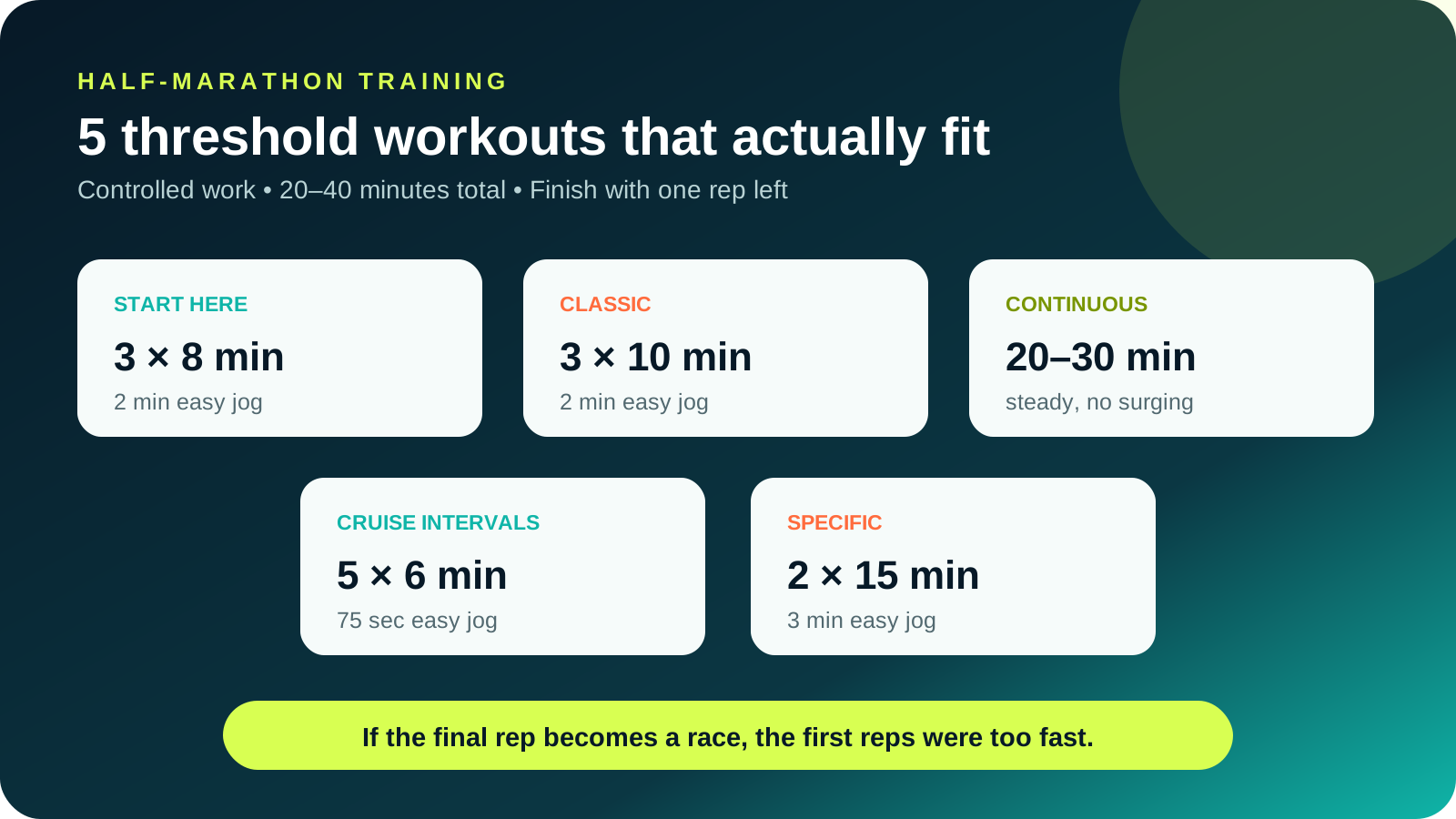
The short answer: the best threshold workouts for half-marathon training accumulate roughly 20–40 minutes of controlled hard running. Start with 3 × 8 minutes with 2-minute easy jogs, progress toward 3 × 10 minutes or 2 × 15 minutes, and use a continuous 20–30-minute tempo only when you can hold the effort without racing. Threshold should feel strong but repeatable—about 7 out of 10—not like a 5K finish.
Threshold training sits close to the intensity you can sustain while lactate production and clearance remain near balance. The exact physiological boundary is individual and definitions vary, which is why one universal heart-rate percentage or pace is unreliable. For practical training, the goal is simpler: run fast enough to create a sustained aerobic stimulus while staying controlled enough to complete the planned work with stable form.
This guide covers the best threshold workouts for half-marathon training, how to choose the right intensity, how to progress the sessions and where they fit in a four- or five-day week.
What Should Threshold Effort Feel Like?
Threshold is often described as approximately one-hour race effort, but that shortcut works better for trained runners than beginners. Depending on ability, threshold pace may fall near 10K pace, between 10K and half-marathon pace, or only slightly faster than half-marathon pace. Use several signals rather than forcing one number.
| Signal | Useful threshold cue | Warning sign |
|---|---|---|
| Perceived effort | About 7/10; focused and controlled | 8.5–9/10 from the first repetition |
| Speech | Short phrases possible | Only isolated words or gasping |
| Pace | Stable or slightly faster late | Large fade despite trying harder |
| Breathing | Deep, rhythmic and controlled | Rapidly escalating with poor form |
| Finish | Could complete one more repetition | Final repetition becomes an all-out race |
Heart rate can confirm effort after it has stabilised, but it lags during short repetitions and changes with heat, fatigue, caffeine and dehydration. Laboratory testing can identify individual thresholds more precisely, yet even a test is a snapshot. On the road, combine recent race performance, pace stability and perceived effort.
The running pace and split calculator can convert a recent realistic race result into useful reference splits. Do not use a goal time that you cannot currently support.
For a complete framework beyond threshold alone, use the half marathon training paces guide to set easy, steady, race-pace and interval sessions from current fitness.
The 5 Best Threshold Workouts for Half-Marathon Training
1. 3 × 8 minutes — the starting workout
Run three repetitions of eight minutes at controlled threshold effort with two minutes of easy jogging. Including a 15–20-minute warm-up and 10–15-minute cool-down, the session remains manageable for runners new to structured tempo work.
Why it works: the short blocks make it easier to correct pace while accumulating 24 quality minutes. Begin conservatively; the third repetition should resemble the first.
2. 3 × 10 minutes — the classic session
Run three ten-minute repetitions with two minutes easy between them. This creates 30 minutes near threshold without the mental and physical cost of a continuous time trial.
Progression: first stabilise all three repetitions. Later, reduce recovery slightly or add easy running around the workout—do not increase every variable at once.
3. 20–30 minutes continuous — the tempo run
After warming up, run 20 minutes continuously at threshold effort. Experienced runners may progress to 25–30 minutes. The correct pace is the one that remains smooth from start to finish, not the fastest pace you can survive.
Best use: controlled conditions, flat terrain and athletes with reliable pacing. Choose intervals instead when heat, hills or inexperience make intensity difficult to regulate.
4. 5 × 6 minutes — cruise intervals
Run five six-minute repetitions with 60–75 seconds of easy jogging. The brief recoveries keep the aerobic demand high while helping preserve mechanics.
Best use: undulating routes, treadmill training or runners who tend to start continuous tempos too fast. Effort should not drift into 5K intensity simply because each repetition is shorter.
5. 2 × 15 minutes — half-marathon-specific strength
Run two controlled 15-minute blocks with three minutes easy between them. This is a simple, specific session for the middle of a half-marathon build. Stronger runners can extend to 2 × 20 minutes only after 30 minutes is routine.
Best use: intermediate runners with a stable aerobic base. Keep the first block patient and aim for equal pace at comparable effort.
Build a training week that survives real life
Get the free Race-Ready Week printable template and editable planner. Prioritize the sessions that matter, protect recovery and prepare a fallback before work or travel changes the plan.
Two Useful Variations
Threshold hills
Use 4–6 repetitions of four to six minutes on a steady moderate incline, jogging back or continuing easily between blocks. Run by effort rather than flat-road pace. Hills can reduce absolute speed while increasing muscular demand, so keep the grade runnable and avoid sprint mechanics.
Threshold inside a long run
Experienced runners can place 2 × 10–15 minutes at controlled threshold effort inside a 90–110-minute long run. This is demanding because fatigue accumulates from both duration and intensity. Use it occasionally, shorten another quality session and keep the following days easy. Before adding intensity, confirm that your basic duration matches the guide to half-marathon long-run length.
A 6-Week Threshold Progression
| Week | Session | Threshold time | Priority |
|---|---|---|---|
| 1 | 3 × 8 min, 2 min easy | 24 min | Find the correct effort |
| 2 | 4 × 7 min, 90 sec easy | 28 min | Keep pace stable |
| 3 | 3 × 10 min, 2 min easy | 30 min | Extend repetitions |
| 4 — lighter | 3 × 6 min, 2 min easy | 18 min | Absorb training |
| 5 | 2 × 15 min, 3 min easy | 30 min | Build sustained control |
| 6 | 25 min continuous | 25 min | Practise uninterrupted pacing |
This is a workout progression, not a complete training plan. Repeat a week when effort is unstable, and reduce volume when sleep, soreness or life stress compromises recovery. Improvement comes from repeatable sessions rather than forcing a new personal best every week.
Where Threshold Fits in the Training Week
Most recreational half-marathon runners need only one dedicated threshold workout per week. Surround it with easy running and separate it from the long run when possible. Highly trained runners may use more than one moderate or hard stimulus, but that structure depends on higher volume and years of preparation. Use the guide to spacing hard running workouts to decide whether your week needs one or two easy days before the next key session.
| Day | Four-run example | Purpose |
|---|---|---|
| Tuesday | Threshold workout | Primary quality stimulus |
| Thursday | Easy + strides | Aerobic support and mechanics |
| Saturday | Easy or controlled steady | Low-cost support |
| Sunday | Long easy run | Endurance and durability |
For weekly context, use the 12-week half-marathon plan with four runs per week. Athletes running more often should first add easy volume; the guide on weekly half-marathon mileage explains practical ranges.
How Threshold Changes Through a 12-Week Build
- Weeks 1–4: short controlled intervals such as 3 × 8 minutes.
- Weeks 5–8: accumulate 28–35 minutes through 3 × 10 or 5 × 6 minutes.
- Weeks 9–10: use longer blocks or occasional half-marathon-specific combinations.
- Weeks 11–12: reduce total work while retaining short familiar efforts.
For a demanding time goal, threshold is one part of readiness rather than proof by itself. The sub-1:30 half-marathon guide combines it with race benchmarks, long-run durability and pacing.
Common Threshold-Training Mistakes
- Using aspirational goal pace instead of current fitness.
- Starting the first repetition faster than the last.
- Turning every recovery into standing rest.
- Chasing heart rate before it has time to stabilise.
- Adding threshold volume while also increasing mileage and long-run duration.
- Doing two threshold sessions because one session went well.
- Treating hot, humid or hilly conditions as irrelevant.
Research reviews support threshold or tempo training as one component of distance-running preparation, while also showing that successful runners perform most training below threshold. A quality workout works because it sits inside a sustainable programme, not because it dominates the programme.
When to Stop or Modify the Session
Slow down or end the workout if pain changes your mechanics, pace collapses at the same effort, dizziness appears, or breathing feels abnormal for the workload. One shortened session has little effect on a training block; forcing it can affect several days.
When conditions are unusually hot, reduce pace and use perceived effort. After travel, illness or poor sleep, convert the session to easy running or reduce the number of repetitions.
Frequently Asked Questions
Is threshold pace the same as half-marathon pace?
Not always. For many trained amateurs, threshold is somewhat faster than half-marathon pace. For faster runners the two may be closer. Use current fitness and effort rather than a universal conversion.
How many minutes of threshold should I run?
Start around 20–25 total minutes. Many intermediate runners progress to 30–40 minutes, usually split into intervals. More is not automatically better.
How often should I do threshold workouts?
Once per week is enough for most recreational half-marathon runners. Beginners may use one session every seven to ten days.
Can I do threshold on a treadmill?
Yes. Use effort and breathing because treadmill calibration and cooling vary. A small incline is optional; there is no need to force exactly 1%.
Should threshold intervals have complete rest?
Usually no. Short easy jogging keeps the session aerobic and prevents each repetition becoming a separate race. Longer recovery may be appropriate when returning to training.
Build the threshold work into a complete plan
The Endurance Unpacked Half Marathon PB Plan includes four- and five-day schedules, English and French guides, an editable workbook, threshold progressions, long runs and race-week tools.
See the complete plan — €19Sources and Further Reading
- Faude et al.: Lactate threshold concepts and endurance-performance validity.
- Casado et al.: Systematic review of distance-running periodization, methods and intensity distribution.
- Systematic review of training-intensity distribution in middle- and long-distance runners.
- Billat: Interval training for middle- and long-distance running.
- Bassett and Howley: Physiological determinants of endurance performance.
Complete the half-marathon block
Arrive fresh with the final two-week taper, plan when to take your gels, and use the missed-week return guide when real life interrupts training.
Editorial note: Vincent Meheut is an amateur runner and long-course triathlete, not a certified coach. This article combines practical experience with cited research and is provided for general education only.