

Half Marathon Hydration Plan by Finish Time and Weather
Build a safer, practical drinking plan from your sweat rate, likely race duration, conditions and the aid stations actually available.
The short answer: start normally hydrated, then drink to thirst within a plan rehearsed in similar conditions. Most half-marathon runners do not need to replace every millilitre of sweat, and nobody should drink faster than they are losing fluid. Use cool-weather training to learn your baseline, repeat the test in heat, and arrange small drinks around aid stations. For many runners, roughly 100–200 mL at selected stations is more practical than forcing a fixed cup every mile—but your pace, sweat rate and weather decide how many stations you need.
A half marathon sits in an awkward middle ground. Faster runners may finish in little more than an hour, while others spend two and a half hours or longer on course. One runner barely sweats on a cool morning; another loses more than a litre per hour in humidity. A single universal instruction such as “drink 500 mL every hour” can therefore be too much for one athlete and too little for another.
This guide gives you a method rather than a rigid prescription. It explains how to estimate sweat rate, turn race duration into an aid-station plan, adjust for heat, coordinate water with carbohydrate, and avoid the dangerous mistake of drinking beyond need.
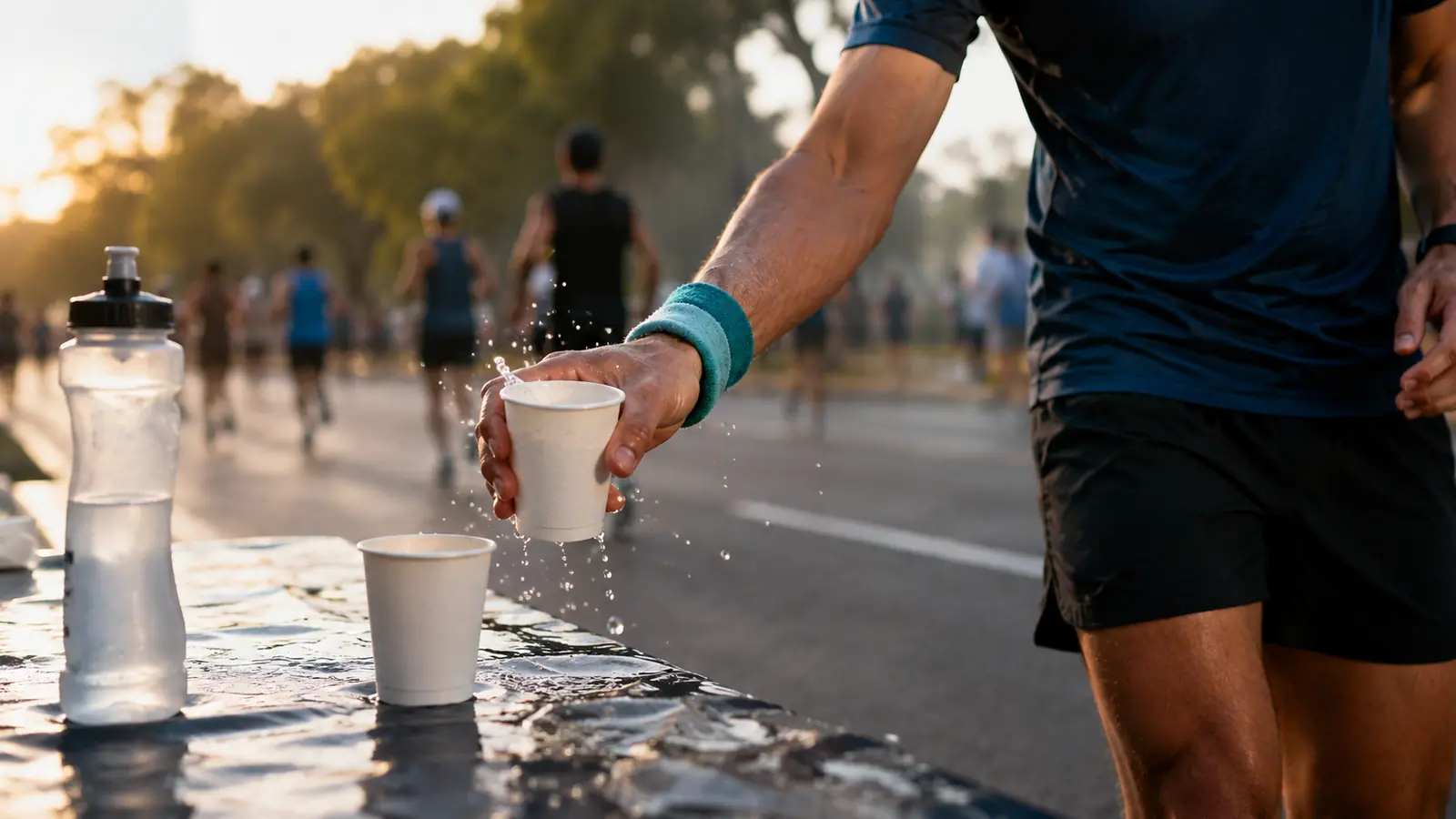
How to Hydrate Before a Half Marathon
Your goal is to begin in normal fluid balance—often called euhydration—not to store extra water. Drink normally during the previous day, include fluid with meals, and use thirst, urine frequency and urine colour as practical checks. Pale straw-coloured urine is generally reassuring. Completely clear urine all morning is not a performance target.
The American College of Sports Medicine suggests allowing several hours for pre-exercise fluid to be absorbed and excess urine to be passed. A useful starting point when extra prehydration is needed is approximately 5–7 mL per kilogram of body mass about four hours before exercise. For a 70 kg runner, that is 350–490 mL. If you have not urinated or the urine remains very dark, a further modest amount may be appropriate about two hours before the start.
| Body mass | 5 mL/kg | 7 mL/kg | What this means |
|---|---|---|---|
| 50 kg / 110 lb | 250 mL | 350 mL | A glass to a small bottle |
| 60 kg / 132 lb | 300 mL | 420 mL | Drink gradually with breakfast |
| 70 kg / 154 lb | 350 mL | 490 mL | About 12–17 fl oz |
| 80 kg / 176 lb | 400 mL | 560 mL | Split it rather than chugging |
| 90 kg / 198 lb | 450 mL | 630 mL | Needs still depend on baseline status |
This is a starting guide, not an instruction to add that volume on top of everything you already drink. Your pre-half-marathon breakfast may already include water, milk, coffee, juice or sports drink. Count them together.
How to Estimate Your Running Sweat Rate
Sweat rate is the most useful personal input because it reveals the scale of your fluid loss. It varies with temperature, humidity, sunlight, wind, pace, body size, clothing and heat acclimation. A result from a cool easy run should not be copied to a hot race at threshold-like effort.
- Use a run lasting about 60 minutes in conditions relevant to your race.
- Weigh yourself without shoes and in minimal dry clothing immediately before the run.
- Record everything you drink during the run.
- Weigh again immediately afterward, towelled dry and in the same clothing state.
- Record urine passed during the test, if any.
Sweat loss (L) ≈ pre-run mass (kg) − post-run mass (kg) + fluid consumed (L) − urine produced (L)Sweat rate (L/h) = sweat loss ÷ exercise time in hoursWorked example
A runner weighs 70.0 kg before a 60-minute run and 69.4 kg afterward. They drink 300 mL and do not urinate:
- Body-mass change: 0.6 kg
- Fluid consumed: 0.3 L
- Estimated sweat loss: 0.9 L
- Estimated sweat rate: 0.9 L/h
This does not mean they must drink 900 mL every hour. Full replacement may be impractical or uncomfortable, particularly in a shorter race. It means that 200 mL per hour is unlikely to cover much of the loss in similar conditions, while any plan approaching or exceeding 900 mL per hour needs strong justification and careful testing.
Repeat the test. Research shows large differences in both sweat rate and sweat sodium between athletes, and meaningful changes within the same athlete across environments. Two or three field measurements are more informative than one precise-looking number.
Half Marathon Hydration Plan by Finish Time
The table below is an execution framework for temperate conditions, not a prescription. “Small drink” means roughly 100–200 mL—the actual amount in race cups varies. Drink according to thirst and your rehearsed needs; skip a station if you are comfortable and conditions are cool.
| Expected finish | Practical cool-weather starting plan | Likely execution | Main mistake to avoid |
|---|---|---|---|
| Under 1:25 | Pre-race hydration may cover much of the race; drink to thirst | One or two small drinks, often coordinated with carbohydrate | Losing time and comfort by forcing every station |
| 1:25–1:45 | Use selected stations, guided by thirst and training | Two or three small drinks spaced through the race | Waiting until severe thirst, then gulping a full cup |
| 1:45–2:15 | Plan regular opportunities rather than exact compulsory volume | Three or four small drinks; more in warm conditions if tested | Combining every water and sports-drink station blindly |
| 2:15–2:45 | Duration makes an intentional plan more important | Small drinks roughly every 25–35 minutes, adjusted to need | Following a fast runner’s minimalist plan |
| Over 2:45 | Use sweat-rate evidence and frequent access | Carry fluid or map stations if gaps are long | Drinking on a timer despite fullness, bloating or weight gain |
Convert your predicted finish into pace and checkpoint times with the running pace calculator. Then place aid stations on that timeline. A station at 10 km arrives around 40 minutes for one runner and 70 minutes for another; time matters more than the kilometre number.
Aid-station example for a 1:50 runner
Imagine stations at kilometres 5, 10, 15 and 18. A runner who has rehearsed small drinks might take water at 5 km, take a gel just before water at 10 km, reassess thirst at 15 km, and use 18 km only if needed. That is more deliberate than treating all four stations as mandatory.
Use the race fueling calculator to combine duration, conditions, body mass and carbohydrate into one starting plan. The calculator is a planning tool; real-time symptoms and event medical advice take priority.
How Heat and Humidity Change the Plan
Heat usually increases sweat loss and cardiovascular strain. Humidity reduces evaporative cooling, so you can feel hotter even when sweat is pouring off you. Direct sun, still air and a dense start corral add further load. The correct response is not merely more water: pace, acclimation, cooling, sodium losses and access all matter.
Use a three-part adjustment
- Reduce the pace expectation. A realistic effort lowers heat production. Use the half marathon pacing strategy and start conservatively.
- Increase access, not compulsory intake. Plan more opportunities to drink or carry a soft flask. Continue to respond to thirst and rehearsed tolerance.
- Add cooling. Shade before the start, light clothing, water over the head when appropriate, and ice provided by the event can reduce thermal strain without adding fluid to the stomach.
| Conditions | Planning adjustment | Race execution |
|---|---|---|
| Cool, low humidity | Use cool-weather sweat tests | Thirst may be modest; do not drink from habit alone |
| Mild or sunny | Add an extra access point | Small sips; monitor effort and rising thirst |
| Warm and humid | Use a heat-specific sweat test and slower pace | Frequent access, cooling, tested electrolyte strategy |
| Unexpected extreme heat | Abandon rigid time targets | Follow race alerts; slow or stop if warning symptoms appear |
Heat acclimation changes sweating and perception over time, which is another reason to retest rather than extrapolate from winter training. The 2023 IOC consensus recommends monitoring weight, urine and thirst together during periods of training and competition in the heat.
Water, Electrolytes or Sports Drink?
Water
Water works well when breakfast and normal meals have provided sodium and carbohydrate is taken separately. It is the easiest choice with standard gels, which are often best followed by water.
Electrolyte drink
An electrolyte drink may be useful in heat, for longer finish times, or for athletes with high measured sweat sodium losses. The label matters: some products contain mainly sodium, while others also deliver significant carbohydrate. “Electrolytes” does not automatically mean adequate fuel.
Sports drink
Sports drink combines fluid and carbohydrate, often with sodium. It can simplify the plan, but race cups are inconsistently filled and the on-course product may differ from what you trained with. Learn the brand, concentration and approximate cup volume before race day when the organiser publishes them.
Coordinate all carbohydrate with the guidance in when to take gels during a half marathon. A gel plus a full-strength sports drink is not inherently wrong, but it creates a more concentrated carbohydrate dose and should be intentional.
Does sodium prevent hyponatremia?
Sodium can help replace sweat losses and support fluid retention, but it does not make overdrinking safe. Exercise-associated hyponatremia is most strongly linked to consuming fluid beyond need, sometimes enough to gain weight during the event. The principal safeguard is avoiding excessive intake; salt tablets are not permission to keep drinking.
Build a training week that survives real life
Get the free Race-Ready Week printable template and editable planner. Prioritize the sessions that matter, protect recovery and prepare a fallback before work or travel changes the plan.
How Much Should You Carry?
Start with the course map. If aid stations are frequent and provide the fluid you tested, carrying nothing may be simplest. If the weather is hot, stations are far apart, or the event drink is unfamiliar, a small soft flask can provide control.
| Option | Advantage | Trade-off | Best use |
|---|---|---|---|
| Course cups | No weight to carry | Uncertain volume; congestion | Frequent stations and familiar products |
| 250–500 mL soft flask | Known drink and easy sipping | Weight and carrying comfort | Long gaps or specific drink mix |
| Handheld bottle | Simple access | Can alter arm swing | Runners already accustomed to it |
| Hydration vest | High capacity and storage | Often unnecessary for road halves | Trail events or sparse unsupported courses |
Do not carry a vest for the first time because the forecast changed. Equipment that rubs, bounces or changes posture can create a new problem. Practise with the exact filled weight.
How to Rehearse Your Hydration Plan
Use two or three long runs or race-specific sessions during your training block. Match the likely start time and, when possible, the temperature. Build the test into a structured week rather than adding an extra hard effort.
- Check the event’s aid-station locations and products.
- Estimate the time—not just distance—at which you will reach each station.
- Choose which stations are opportunities for water, sports drink or an optional skip.
- Practise drinking from a cup while moving at controlled pace.
- Record pre/post mass, fluid consumed, thirst, temperature and stomach comfort.
- Change one variable and repeat.
Your half marathon training paces matter here: an easy run may underestimate the gut and heat strain of race effort. A long run containing controlled half-marathon-pace sections can reveal whether the plan is still comfortable when breathing and intensity rise.
The cup technique
Approach predictably, make eye contact with the volunteer, and point to the cup you want. Pinch the rim into a narrow spout, take several small sips, then move away before slowing. Walking five to ten seconds can be faster overall than coughing, spilling the cup or upsetting your stomach.
Three Complete Hydration Examples
Example 1: 1:25 in cool conditions
The runner arrives normally hydrated after a familiar breakfast. Their cool-weather sweat rate is modest. They take a small drink near 6 km and water with a gel near 12 km, then use thirst to decide on the final station. They do not force fluid merely because cups are available.
Example 2: 1:50 in mild sun
The runner’s relevant sweat tests range from 0.7–0.9 L/h. They plan approximately 150 mL at three stations, with a fourth available if thirst rises. Two gel doses are paired with water. The total will not replace all sweat loss, but it is comfortable, rehearsed and below the measured loss rate.
Example 3: 2:25 in warm humidity
The runner has practised in the heat and carries a 500 mL flask because the first station is late. They reduce target pace, use small station drinks after the flask, take carbohydrate and sodium through a tested sports drink, and use water for cooling. The plan provides frequent access without making every cup compulsory.
Put hydration inside the whole race plan
The €19 12-Week Half Marathon PB Plan includes English and French guides plus an editable workbook, covering training structure, pacing, fueling, taper and race-day execution.
See the complete 12-week planCommon Half Marathon Hydration Mistakes
- Following a fixed hourly volume without measuring sweat or considering weather.
- Trying to replace 100% of sweat loss during a short race.
- Drinking at every station despite fullness, bloating or no thirst.
- Copying a cool-weather plan into humid heat.
- Taking gels with sports drink without counting total carbohydrate concentration.
- Assuming electrolyte tablets eliminate the risk of overhydration.
- Using a new flask, vest or caffeinated drink on race morning.
- Ignoring pace: an aggressive start raises heat production and gut stress.
Frequently Asked Questions
Do I need to drink during a half marathon?
Many runners will benefit from at least some fluid, particularly when racing longer than about 90 minutes or in warm conditions. A fast runner in cool weather may need very little. Start hydrated, use thirst and training evidence, and avoid treating either “never drink” or “drink every mile” as a universal rule.
How many water stations should I use?
It depends on their spacing, your finish time, sweat rate and conditions. Two stations can be enough for one cool 75-minute race, while a warm two-hour race may require more frequent access. Plan in minutes and approximate volumes rather than station count alone.
Should I carry water for a half marathon?
Carry it when course access is insufficient, the event drink is unsuitable, or a familiar flask improves execution. If stations are frequent, carrying extra weight may offer little benefit. Test the choice in training.
Is 500 mL per hour the correct amount?
It is a common middle-of-the-road number, not a personal answer. Your relevant sweat rate might be 0.4 L/h or above 1 L/h. Use measured losses, thirst, conditions and tolerance, and never drink faster than the rate at which you are losing fluid.
Can I drink too much water during a half marathon?
Yes. Drinking beyond sweat and urine losses can dilute blood sodium. Weight gain during an endurance event is a warning sign of overconsumption. Headache, confusion, vomiting, swollen hands or altered behaviour require urgent medical attention rather than more forced water.
Do electrolytes prevent muscle cramps?
Not reliably. Cramps can reflect fatigue, pacing, neuromuscular factors, heat and individual susceptibility as well as fluid-electrolyte issues. A tested electrolyte plan may replace losses, but it cannot compensate for an unrealistic pace or inadequate preparation.
What should I drink after the finish?
Resume drinking according to thirst and include fluid and sodium with normal food. If rapid recovery is required and you have measured a substantial deficit, structured replacement may help. Seek medical help for confusion, persistent vomiting, collapse or worsening symptoms instead of self-treating with large amounts of water.
Sources and Further Reading
- American College of Sports Medicine: Exercise and Fluid Replacement.
- Third International Exercise-Associated Hyponatremia Consensus Statement.
- Baker: Sweating Rate and Sweat Sodium Concentration in Athletes.
- Maughan and Shirreffs: Dehydration and Rehydration in Competitive Sport.
- IOC consensus statement on recommendations and regulations for sport events in the heat.
- World Athletics: Nutrition Strategies for Distance Runners and Race Walkers.
Editorial disclosure: Vincent Meheut is an experienced endurance athlete and the editor of Endurance Unpacked. He is not a certified coach, registered dietitian or medical professional. This article provides general education, not personalised hydration, nutrition or medical advice.