

Half Marathon Pacing Strategy: Even, Negative or Positive Split?
A practical plan for turning fitness into a controlled race instead of spending it in the first five kilometres.
The short answer: the best half marathon pacing strategy for most runners is controlled-even effort with the option of a small negative split. Start the first 2–3 km a few seconds per kilometre slower than goal pace, settle near goal effort through 15–16 km, then accelerate only if effort, breathing and mechanics remain controlled. A deliberate positive split—starting faster and accepting a fade—is rarely the safest route to your best result.
Pacing is the allocation of limited energy across 21.1 kilometres. The fastest theoretical strategy is not always perfectly even pace because hills, wind, turns, temperature and crowding change the cost of each kilometre. The useful target is therefore even physiological effort, not blind obedience to a GPS number.
This guide compares even, negative and positive splits, gives exact race plans for common finishing goals, and explains how to adjust without turning every small pace change into panic.
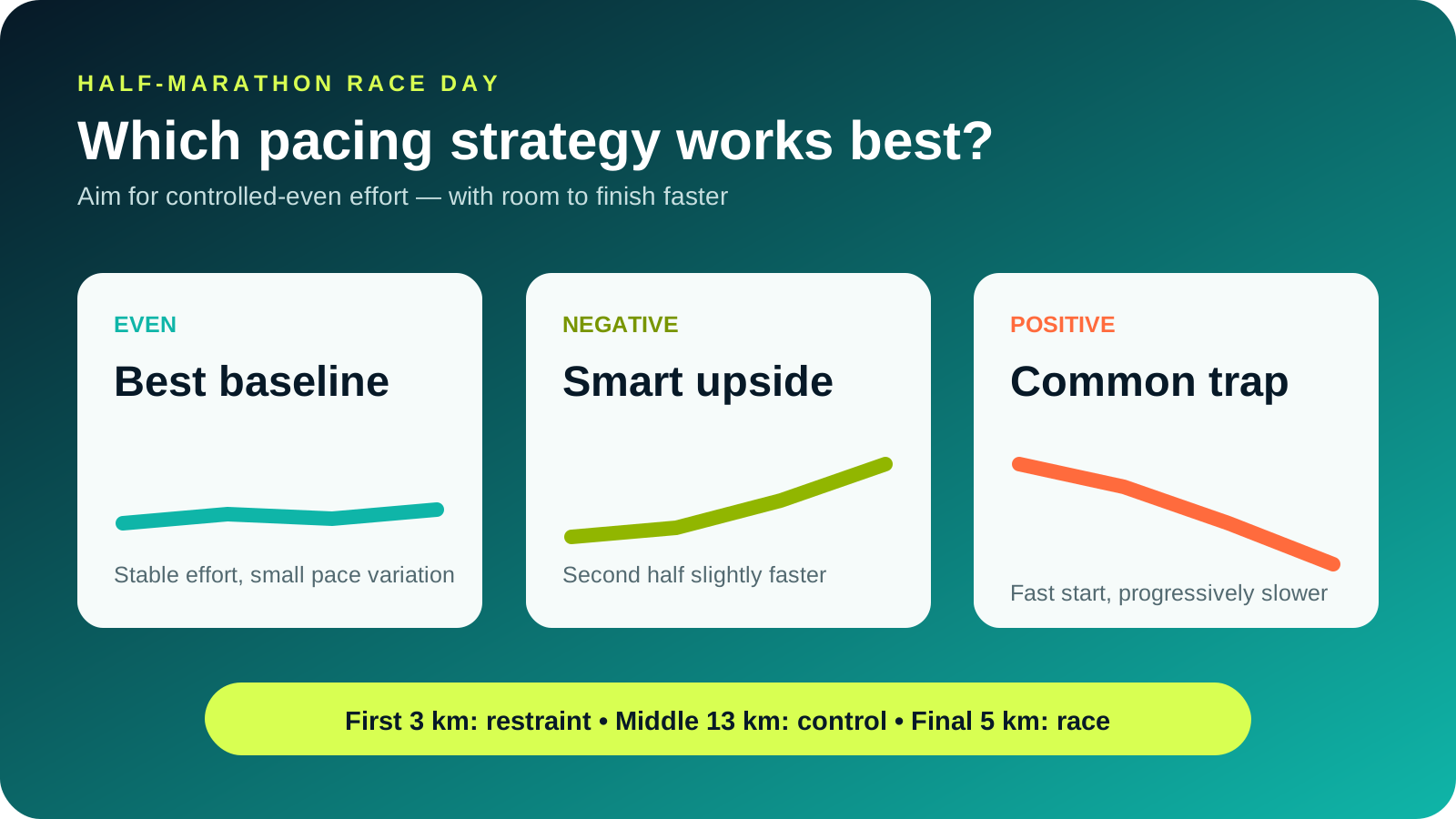
Even, Negative and Positive Splits Explained
| Strategy | What it means | Potential advantage | Main risk |
|---|---|---|---|
| Even split | Both halves take similar time | Efficient and predictable | Can become rigid on hills or in wind |
| Negative split | Second half is faster | Protects the start and rewards good judgment | Starting too slowly can leave time unused |
| Positive split | Second half is slower | Sometimes results naturally from conditions | An aggressive start can create a large late fade |
Large half-marathon datasets show that recreational runners commonly slow as the race progresses. That observation does not prove that every positive split is a tactical mistake: courses and weather matter, and a small fade can accompany an excellent performance. It does show why “banking time” should be treated sceptically. Faster early kilometres cost more than the same seconds are worth later when they push effort above a sustainable level.
A negative split is not a guarantee either. Running the first half far below ability and sprinting late may feel satisfying but can produce a slower total time. The ideal outcome for most PB attempts is a narrow range: patient opening kilometres, stable middle pace and a finish determined by remaining capacity.
Choose a Goal Pace Before Choosing a Split
A pacing strategy cannot rescue an unrealistic target. Use this five-step method for setting a realistic half marathon goal time, building the goal from several independent signals rather than one perfect workout or a previous personal best achieved in different conditions.
- Recent race evidence: a properly paced 10K completed in the previous six to eight weeks is usually more informative than an old half-marathon result.
- Training consistency: goal pace is more credible when weekly volume and long runs have been repeatable, not assembled during one exceptional week.
- Specific sessions: controlled blocks at half-marathon effort should finish with stable mechanics and without several days of recovery.
- Course and conditions: elevation, turns, surface, temperature and wind can make the same fitness produce a different finishing time.
Prediction formulas are useful starting points, not guarantees. Fatigue resistance varies: two runners with the same 10K time can have very different half-marathon outcomes. Use the calculator, then test the proposed effort inside training rather than forcing training to confirm the calculator.
Build A, B and C targets
A target: the ambitious outcome supported by excellent conditions and a strong final five kilometres.
B target: the central goal supported by current evidence.
C target: a controlled performance when heat, wind or the opening kilometres make the original time inappropriate.
All three targets should preserve sensible execution. A C target is not permission to stop racing; it is a decision made before frustration creates a worse one.
Which Strategy Fits Which Runner?
| Situation | Recommended approach | Why |
|---|---|---|
| First half marathon | Conservative start, even effort | Protects against an unknown late-race response |
| Experienced runner chasing a PB | Near-even split with slight negative option | Uses fitness without closing the race too early |
| Hot, windy or hilly course | Even effort, variable pace | Prevents expensive attempts to hold flat-course pace |
| Goal fitness uncertain | Start at B-goal effort and reassess at 10 km | Creates evidence before increasing commitment |
| Championship or tactical race | Position and competition may override even pace | The goal is place rather than fastest possible time |
The Four-Stage Half-Marathon Pacing Plan
Stage 1 — kilometres 0–3: protect the race
Run by restraint. Crowds, adrenaline and fresh legs make goal pace feel unusually easy. Aim approximately 3–8 seconds per kilometre slower than goal pace, depending on ability and congestion. Do not weave repeatedly to recover a few seconds.
Stage 2 — kilometres 3–10: lock into goal effort
Move gradually toward goal pace. Check breathing, posture and perceived effort rather than chasing every instant-pace fluctuation. At 10 km you should be working, but the prospect of another 11 km should feel credible.
Stage 3 — kilometres 10–16: hold the line
This is where pacing becomes discipline. Maintain effort through small gradients and wind changes. Do not accelerate merely because another runner passes. If goal pace already feels like a finishing effort, reduce slightly before the slowdown becomes involuntary.
Stage 4 — kilometres 16–21.1: spend what remains
Assess honestly at 16 km. If breathing is controlled and form is stable, increase effort progressively. Think in checkpoints: reach 18 km, then 20 km, then race the final 1.1 km. A five-kilometre surge is not required; even a modest lift after a controlled middle can create a negative split.
Pacing Examples for Common Goals
| Goal | Average pace | First 3 km | 3–16 km | Final 5.1 km |
|---|---|---|---|---|
| 1:30 | 4:16/km · 6:52/mi | 4:19–4:22/km | About 4:15–4:17/km | Hold, then progress if able |
| 1:45 | 4:59/km · 8:01/mi | 5:03–5:07/km | About 4:57–5:00/km | Move below 4:58/km if controlled |
| 2:00 | 5:41/km · 9:09/mi | 5:46–5:51/km | About 5:39–5:43/km | Maintain or gradually accelerate |
For finish times from 1:10 to 3:00, use the complete half marathon pace chart with kilometre, mile and 5K splits. These bands are examples, not promises. The official distance is 21.0975 km, but GPS devices often record farther because of turns, imperfect racing lines and measurement error. To finish under a target, your watch may need to show a slightly faster average than the mathematical pace. Avoid compensating all at once; build a small buffer gradually.
For a sub-90 attempt, use the dedicated sub-1:30 half-marathon guide to assess whether the goal is supported by recent performance and training.
Build a training week that survives real life
Get the free Race-Ready Week printable template and editable planner. Prioritize the sessions that matter, protect recovery and prepare a fallback before work or travel changes the plan.
Pace the Effort When Conditions Change
Hills
Allow pace to slow uphill without matching the flat-road number through excessive effort. Use the descent to regain time gradually, not with braking or an uncontrolled sprint. On a rolling course, even effort can produce uneven kilometre splits and still be the correct strategy.
Wind
A headwind increases the cost of pace. Run with a group when it matches your effort, stay smooth and accept slower splits. With a tailwind, regain time through the same controlled effort rather than forcing a surge.
Heat and humidity
Use a more conservative target when conditions are materially hotter than training or recent races. Heart rate and perceived effort can rise at the same pace. The right adjustment depends on acclimation, humidity and exposure; no single percentage fits everyone.
Crowding and turns
Seed yourself honestly and accept the first kilometre. Repeated weaving adds distance and abrupt accelerations. Run tangents where safe, but do not compromise other runners.
How to Use Your Watch Without Letting It Pace You
- Display lap pace: more stable than instant pace.
- Use manual or course markers: GPS distance can drift.
- Show total elapsed time: confirm progress at 5 km, 10 km and 15 km.
- Add heart rate as context: do not chase a fixed number during the opening minutes.
- Avoid constant checking: use the watch to confirm a plan, not replace awareness.
Three useful checkpoints
5 km: Am I controlled enough to continue?
10 km: Does this goal still match today?
16 km: Can I increase effort without losing mechanics?
How to Practise Pacing Before Race Day
Race pace should feel familiar before it becomes consequential. Use controlled blocks inside a medium-long or long run: for example, 3 × 3 km at intended half-marathon effort with 1 km easy, or 2 × 15 minutes within a longer easy run. The goal is not to prove you can race in training; it is to calibrate effort and learn how pace changes with fatigue.
Threshold work supports sustainable speed but is usually faster than half-marathon pace. Use the threshold-workout guide to keep those two purposes distinct, and the long-run guide to control total session cost.
What to Do When the Race Moves Off Plan
You are 20–30 seconds behind early
Do not recover the gap in one kilometre. Return gradually to intended effort and let several kilometres close part of it. A congested start is frustrating, but a sharp surge can cost more than the delay.
Goal pace feels too hard before 8 km
Reduce effort early. Check whether the cause is an unrealistic target, heat, a hill, illness or simply one difficult patch. Give the new pace time to stabilise. A small deliberate adjustment protects the possibility of a strong result; denial often turns it into a large involuntary fade.
You feel exceptional at halfway
Hold. Halfway is too early to spend the reserve simply because restraint is working. Reassess near 15–16 km, where an acceleration has a better chance of remaining sustainable.
Your GPS and course markers disagree
Trust official markers for race distance and use the elapsed time between them. GPS can cut corners, drift near buildings or accumulate extra distance. Avoid changing the entire plan based on one noisy kilometre.
Fueling Supports Pacing—It Does Not Fix It
For many runners, a half marathon is long enough for pre-race carbohydrate, fluid planning and an in-race carbohydrate strategy to matter. The exact approach depends on duration, tolerance, conditions and prior practice. Test products during training and avoid taking an unfamiliar gel simply because it is offered on course.
Fueling cannot make an unsustainable opening pace sustainable. It supports the plan by reducing avoidable energy and concentration problems later. Place intake at moments that do not require a surge, use aid stations deliberately and accept a few seconds of pace variation when drinking safely.
Common Pacing Mistakes
- Choosing pace from an aspirational goal rather than current evidence.
- Trying to recover a congested first kilometre immediately.
- Following a pace group that does not match current fitness.
- Holding exact pace uphill or into a headwind.
- Reacting to instant GPS pace every few seconds.
- Making a decisive move at halfway because the race still feels easy.
- Waiting until the final 500 metres to use a large reserve.
Frequently Asked Questions
Is a negative split always best?
No. A small negative split is a useful outcome, but an approximately even race can be equally strong. Large negative splits may indicate an overly cautious start.
How much slower should the first kilometre be?
Usually only a few seconds per kilometre. Congestion may make it slower; do not force an immediate correction.
Should I follow a pacer?
Only when the pacer’s target matches a realistic goal. Pacers can smooth decision-making, but they cannot account perfectly for your fitness or conditions.
Can a positive split still produce a PB?
Yes. A small fade is common and can still accompany an excellent race. The problem is an aggressive opening that creates a disproportionate slowdown.
Should I pace by heart rate?
Use heart rate as supporting information. It responds to heat, hydration, fatigue and cardiac drift, and it lags behind sudden changes in effort.
Want the complete editable plan?
The Endurance Unpacked 12-Week Half Marathon PB Plan connects training paces, long runs, threshold progression, taper and a complete race-day pacing worksheet.
Explore the complete plan — €19Sources and Further Reading
- Pacing differences by performance level in marathon and half-marathon races.
- Pacing of women and men in half-marathon and marathon races.
- Sex differences in pacing during half-marathon and marathon races.
- Pacing profiles and tactical behaviour of elite runners.
- World Athletics: pacing strategy and conservative starts.
Complete the half-marathon block
Arrive fresh with the final two-week taper, plan when to take your gels, and use the missed-week return guide when real life interrupts training.
Editorial note: Vincent Meheut is an amateur runner and long-course triathlete, not a certified coach. This article combines practical experience with cited research and is provided for general education only.